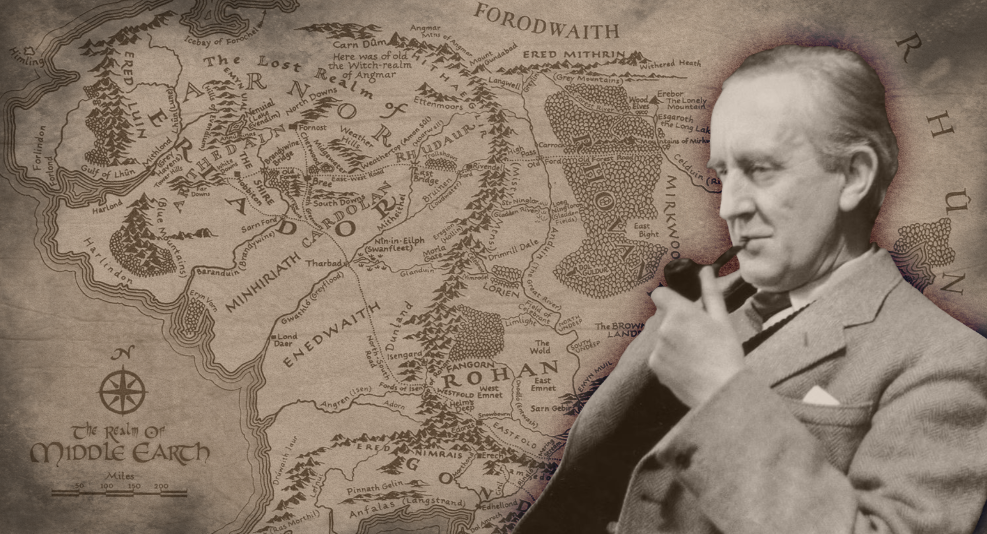
Was J. R. R. Tolkien the God of Middle-earth? This question arises from a debate about God and evil on social media. The issue centered on Calvinism, God’s sovereignty, free will and the problem of evil, among other considerations.
Briefly, Calvinists assert that God knows everything that will happen because He determined everything; but if that’s really the case, then what about evil? As terrible as this example is, does God permit or decree the rape and murder of a little girl? Is God, then, culpable?
In the way of a solution to the dilemma, one Calvinist came up with the following thought experiment involving Tolkien and Middle-earth. To paraphrase:
Tolkien authored all the evil in Middle-earth. But no one who reads the LOTR trilogy really imagines Tolkien as morally culpable for the evil he decreed in that world. ~ A Calvinist analogy
Does this work? Think about that analogy for a few moments. In the meantime, here are some Calvinists on Hard Determinism:
Calvinists speak
If God foresaw what he did not will to be, the he does not have the highest authority. ~Calvin (cited in Scott Christensen’s What about Evil?)
Contra libertarian freedom: The only way that God could know for certain the future choices of his creatures would be to wait for people to make their choices. ~ Scott Christensen (What about Evil?)
“We cannot soft-pedal this dilemma [determinism] by calling it a mystery; we must face up to the full import of the concept. If free will means autonomy, then God cannot be sovereign. If man is utterly and completely free to do as he pleases, there can be no sovereign God. However, if God is utterly sovereign to do as He pleases, no creature can be autonomous.” ~ R. C. Sproul (Can I know God’s Will?)
“Calvinists, I shall assume, are theological determinists. They hold that God causes every contingent event, either directly or indirectly.” ~Matthew J. Hart (Calvinism and the Problem of Hell)
Back to Tolkien
What about that analogy? Is Tolkien the God of Middle-earth? First of all, we should understand that Tolkien was telling a story in which he imbued his characters with the ability to make free-will choices. For example, Tolkien didn’t make Sméagol (Gollum) kill Déagol in order to take the Ring: he recorded the event. In fact, he once confessed,
“I met a lot of things on the way that astonished me. Tom Bombadil I knew already; but I had never been to Bree. Strider sitting in the corner at the inn was a shock, and I had no more idea who he was than had Frodo…’
In J. R. R. Tolkien’s Sanctifying Myth: Understanding Middle-earth, Brad Birzer wrote that Tolkien believed his legendarium to be a single entity revealed to him over time (P 24).
I’m onto my third fantasy novel (not yet published) and can attest to the phenomenon in which characters often reveal themselves to the author in the process of writing. Hence, the Tolkien analogy is not compelling to me.
Some Bible verses suggesting free-will.
“Ah, stubborn children,” declares the LORD, “who carry out a plan, but not mine, and who make an alliance, but not of my Spirit, that they may add sin to sin; Isaiah 30:1
For thus said the Lord GOD, the Holy One of Israel, “In returning and rest you shall be saved; in quietness and in trust shall be your strength.” But you were unwilling, Isaiah 30:15
O Jerusalem, Jerusalem, the city that kills the prophets and stones those who are sent to it! How often would I have gathered your children together as a hen gathers her brood under her wings, and you were not willing! Mat 23:37
You stiff-necked people, uncircumcised in heart and ears, you always resist the Holy Spirit. As your fathers did, so do you. Act 7:51
Or do you presume on the riches of his kindness and forbearance and patience, not knowing that God’s kindness is meant to lead you to repentance? Romans 2:4
Note that the Calvinist James White attempted to defend determinism contra Matt 23:37. Leighton Flowers responded to him: Is James White right about Matt 23:37? You decide if White succeeded or not. Was Christ’s plaint disingenuous?
Last thoughts
I’m a layman with limited grasp of all the Calvinist terms and their interactions with non-Calvinists. But I believe the verses cited above are clear enough if one does not smuggle in determinist presuppositions. These same presuppositions affect how Calvinists must interpret passages such as Romans 9. I recommend this review of Jonathan Williams’ excellent book: Romans 9 and the Story Paul was Telling
The question we should ask ourselves is this: can God make Himself understood plainly by the reader? I think He does.
Maranatha!
Further reading
On the road with Lewis and Tolkien
Romans 9 and the story Paul was telling (affiliate)
Calvinism: A Biblical and Theological Critique (affiliate)
Liberating Romans From Reformed Captivity (affiliate)
Whosoever Will (affiliate)
Salvation and Sovereignty (affiliate)
Paul Henebury: The Parameters of Meaning
Paul Henebury: Is God Disingenuous?
Sharing is caring!